
A polyphonic analog-style synth, played from the guitar you already own.
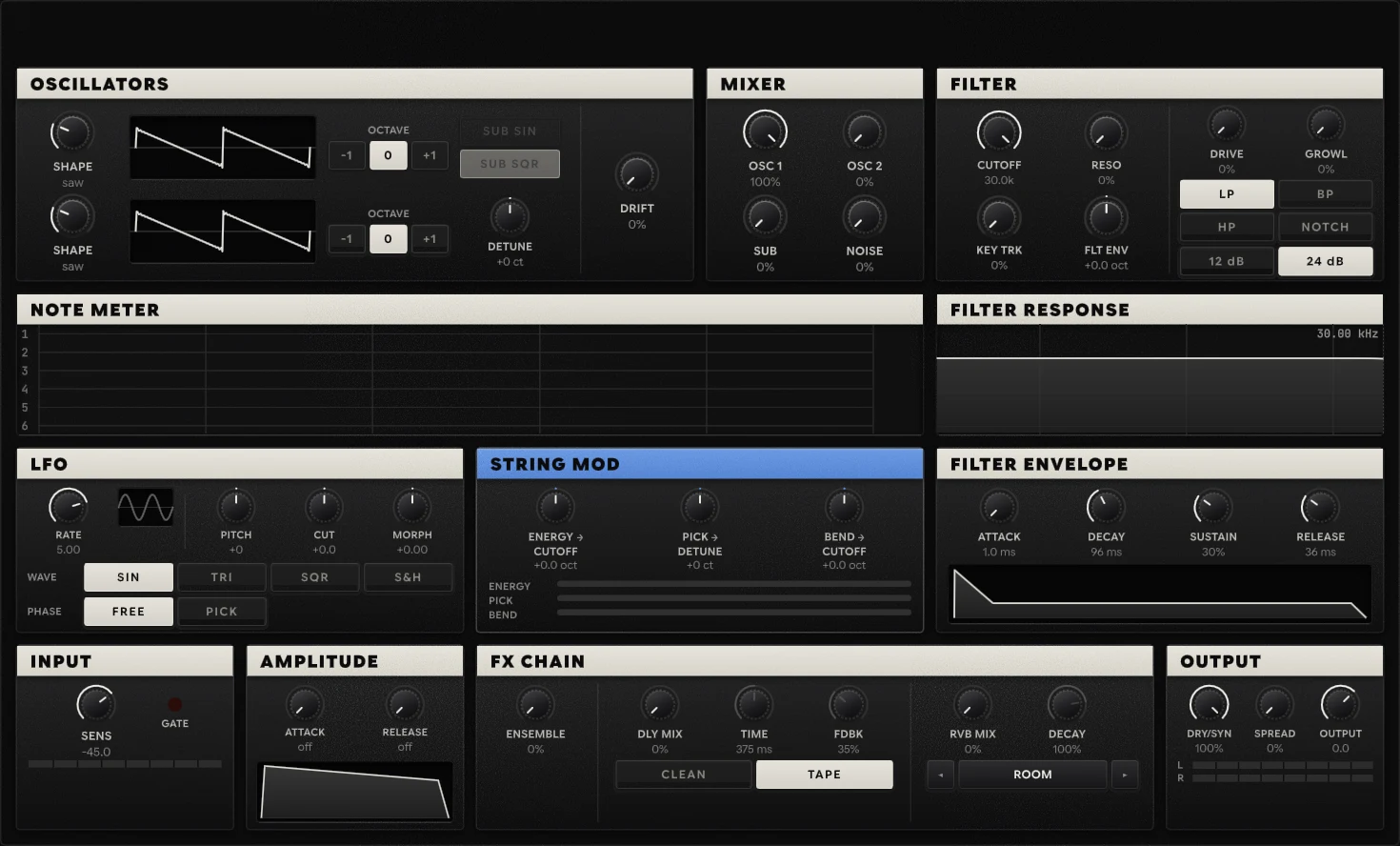
For guitarists who want synth sounds without a hex pickup, a breakout box or a MIDI rig, and for producers who play guitar and want pads, basses and leads from a di track.
Any guitar, no MIDI
Audio goes in, nothing goes on the instrument. A tracker follows up to six notes at once and each note drives its own voice. A seventh note is refused rather than stealing one that is sounding, so a held chord is never cut by a passing note.
The string plays the synth
There is no amp envelope to set: each voice's loudness follows its string, so a palm mute is a palm mute and a swell is a swell. Pick harder and OSC 2 detunes, by up to 50 cents, so the note gets fatter under your hand. Every note starts in tune; DRIFT only wanders after the attack. Your dry guitar is never gated and never delayed: the audio path reports 0 samples.
Measured from a real polysynth
The oscillator shapes, their levels and the voicing EQ were measured from a classic analog polysynth, not drawn by ear. Resonance is capped at 95 % of the point where the filter would self-oscillate, so a loud note never makes it scream.
A sub, a string machine, a tape delay and a room
A phase-locked sub-octave divider, square or sine. An ensemble in the string-machine manner, cleanest at 100 %. A delay from 5 to 3000 ms, CLEAN or TAPE. Six console reverb rooms. All at 0 % until you turn them up.
Four moves to try
- CLEAN DOUBLE. the synth in unison with your guitar.
- DIVIDER BASS. a true sub under a low line.
- A chord through ENSEMBLE into a room. a pad from the guitar you already own.
- HARD PICK BEATS. dig in and hear OSC 2 pull away.
This is not for you if you play keys or want MIDI in or out (there is none), you want guitar-to-MIDI, or you have re:synth and are happy with its signal-derived sounds.